Non-Destructive Testing / FILE 06
Ultrasonic Pulse Velocity Testing
UPV testing measures the speed of ultrasonic waves through concrete to assess quality, detect internal defects, and estimate crack depth. Fast, non-destructive, and effective on all concrete types.
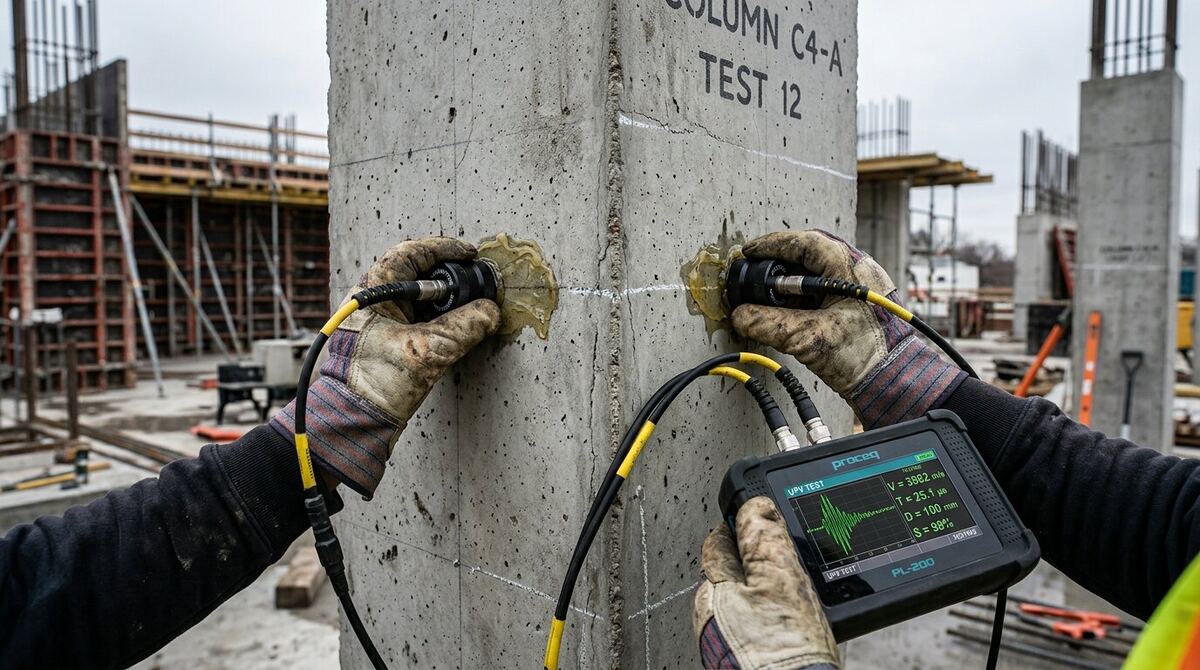 EVIDENCE / UPV-TESTING
Ultrasonic pulse velocity (UPV) testing measures the speed at which ultrasonic waves travel through concrete. Wave velocity is directly related to the elastic modulus and density of the material. Higher quality concrete transmits pulses faster; deteriorated, voided, or cracked concrete transmits them slower.
UPV is particularly valuable for comparative assessment, mapping quality variation across a structure to identify zones of concern. We use UPV in three configurations: direct transmission (transducers on opposite faces), semi-direct (adjacent faces), and indirect (same face). Indirect transmission enables crack depth estimation.
Results are classified according to IS 13311 (Part 1): velocities above 4,500 m/s indicate excellent quality, 3,500 to 4,500 m/s is good, 3,000 to 3,500 m/s is medium, and below 3,000 m/s is doubtful. These classifications guide where further investigation (coring, GPR) should focus.
UPV testing is rapid, portable, and non-destructive. A single measurement takes approximately 30 seconds, and the equipment requires access to the concrete surface only. We typically combine UPV with core testing to correlate velocity data with measured compressive strength.
Capabilities
What we deliver
10 deliverables across the upv testing engagement.
- 01Concrete quality classification (excellent to poor)
- 02Uniformity mapping across structural elements
- 03Crack depth estimation using indirect transmission
- 04Fire damage extent assessment
- 05Repair quality verification
- 06Correlation with core test compressive strength
- 07Marine and coastal structure assessment
- 08Post-tensioned slab quality evaluation
- 09Rapid screening of large structural areas
- 10Portable, non-destructive, no power supply required
Process
Our methodology
01
Test Grid Planning
Definition of test grid locations based on structural elements, investigation objectives, and access. Typically 300mm to 500mm grid spacing for systematic mapping.
02
Surface Preparation & Testing
Surface preparation at each test point, application of acoustic coupling gel, and UPV measurement in the selected transmission mode. Twelve readings per location minimum.
03
Data Analysis
Velocity classification, statistical analysis, contour mapping to visualise quality variation, and correlation with any available core test data.
04
Reporting
Technical report with velocity maps, quality classification, identification of zones requiring further investigation, and recommendations.
Use cases
Common applications
- Concrete quality assessment for existing structures
- Fire damage extent evaluation
- Marine and coastal structure deterioration mapping
- Crack depth estimation
- Quality assurance during construction
- Repair bond and integrity verification
- Heritage building condition assessment
- Pre-demolition structural screening
Frequently asked questions
4 questions answered.
Q01
Can UPV measure concrete compressive strength?
UPV correlates with concrete quality and uniformity, not directly with compressive strength. The relationship between velocity and strength depends on aggregate type, mix design, moisture content, and other factors that vary between structures. We use UPV for quality screening and uniformity mapping, then correlate with core test results from the same structure to establish a site-specific relationship where strength estimation is required.
Q02
How is UPV used after a fire?
Fire reduces concrete quality by causing microcracking, dehydration of cement paste, and aggregate degradation. These changes reduce UPV readings. By comparing velocities in fire-affected zones to unaffected zones of the same structure, we can map the extent and severity of fire damage. Zones with velocity reductions greater than 25 percent typically warrant further investigation with coring and petrographic analysis.
Q03
What is indirect UPV and how does it measure crack depth?
Indirect UPV places both transducers on the same surface with the crack between them. Pulses must travel around the crack, increasing the travel time. By comparing indirect transmission times across the crack to those on uncracked concrete, the crack depth can be estimated geometrically. This technique is effective for surface-breaking cracks and provides a non-destructive alternative to coring.
Q04
Can UPV be used on masonry walls?
UPV can be applied to masonry for comparative purposes. The heterogeneous nature of masonry (mortar joints, units, voids) produces more variable results than concrete. We use UPV on masonry to identify areas of significantly reduced quality rather than absolute classification. Results are interpreted relative to reference readings from sound masonry on the same structure.
Related
Related services
- 01GPR Concrete ScanningSub-surface imaging for rebar mapping, post-tension tendon location, and conduit detection.
- 02Concrete Coring & Laboratory TestingNATA-accredited material testing for compressive strength, carbonation, and chloride analysis.
- 03Corrosion InvestigationHalf-cell potential mapping, resistivity testing, and reinforcement condition assessment.
- 04Building Condition AssessmentFull building surveys, dilapidation reports, and capital works planning.