Non-Destructive Testing / FILE 09
Corrosion Investigation
Reinforcement corrosion is the leading cause of concrete deterioration in Australia. Our corrosion investigations quantify the extent, severity, and rate of corrosion to inform targeted remediation.
 EVIDENCE / CORROSION-IN
Corrosion investigation combines electrochemical testing, material sampling, and engineering analysis to determine the current and future corrosion state of reinforced concrete structures. Reinforcement corrosion is driven by chloride contamination (coastal environments) or carbonation (atmospheric exposure), and is the primary deterioration mechanism for most Australian concrete structures.
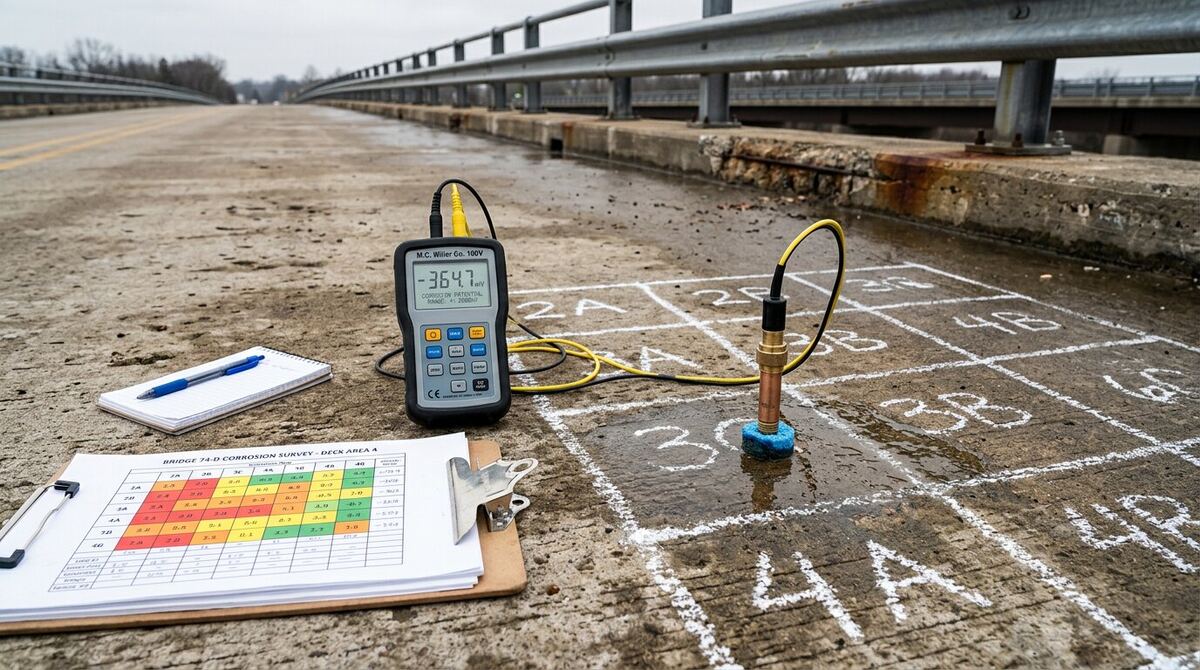
We use half-cell potential mapping (ASTM C876) to identify zones where corrosion is actively occurring. This technique measures the electrical potential between embedded reinforcement and a reference electrode on the concrete surface. Results are presented as contour maps showing the spatial distribution of corrosion probability.
Concrete resistivity testing complements half-cell mapping by indicating the rate at which corrosion can proceed. Low-resistivity concrete supports rapid corrosion; high-resistivity concrete limits the corrosion rate even where corrosion has initiated. The combination of corrosion probability (half-cell) and corrosion rate potential (resistivity) provides a complete corrosion risk profile.
Material testing, including chloride profiling and carbonation depth measurement, quantifies the corrosion drivers. This data feeds into durability models (Fick's second law diffusion analysis) that predict remaining service life and inform maintenance timing.
Capabilities
What we deliver
10 deliverables across the corrosion investigation engagement.
- 01Half-cell potential mapping (ASTM C876)
- 02Concrete resistivity mapping (Wenner probe)
- 03Chloride profiling and diffusion modelling
- 04Carbonation depth measurement
- 05Corrosion probability contour mapping
- 06Remaining service life prediction
- 07Cover depth survey (Ferroscan/GPR)
- 08Visual and break-out inspection of reinforcement
- 09Cathodic protection system design input
- 10Corrosion rate monitoring installation
Process
Our methodology
01
Baseline Assessment
Visual inspection, cover depth survey, and identification of corrosion indicators (staining, cracking, delamination, spalling) to establish the investigation scope and test grid.
02
Electrochemical Testing
Half-cell potential mapping and concrete resistivity testing on a systematic grid across the structure. Results are recorded digitally for contour map generation.
03
Material Testing
Chloride profiling and carbonation depth measurement at selected locations to quantify the corrosion drivers and provide input data for durability modelling.
04
Analysis & Reporting
Corrosion contour maps, durability modelling, remaining service life prediction, and remediation recommendations ranging from monitoring to cathodic protection.
Use cases
Common applications
- Coastal and marine structure assessment
- Multi-storey car park deterioration mapping
- Bridge substructure corrosion assessment
- Swimming pool and water-retaining structure evaluation
- Aged building remediation scoping
- Post-tensioning tendon corrosion risk assessment
- Infrastructure asset management data collection
- Strata building maintenance planning
Frequently asked questions
4 questions answered.
Q01
What causes reinforcement corrosion in concrete?
Two primary mechanisms. Chloride-induced corrosion occurs in coastal, marine, and de-icing salt environments where chloride ions penetrate concrete and break down the protective passive layer on reinforcement. Carbonation-induced corrosion occurs when atmospheric carbon dioxide neutralises the concrete alkalinity, lowering the pH and removing passive protection. Both mechanisms require moisture and oxygen to sustain the corrosion process.
Q02
How does half-cell potential mapping work?
A copper/copper sulphate reference electrode is placed on the concrete surface while an electrical connection is made to the embedded reinforcement. The voltage difference measured between the two indicates the thermodynamic tendency of the steel to corrode at that location. Readings more negative than minus 350mV indicate greater than 90 percent probability of active corrosion. Readings less negative than minus 200mV indicate greater than 90 percent probability of no active corrosion.
Q03
Can corrosion be stopped without replacing the concrete?
Yes, several intervention strategies exist depending on the corrosion mechanism and severity. Cathodic protection applies a small electrical current to prevent further corrosion without concrete removal. Migrating corrosion inhibitors can be applied to the concrete surface. Electrochemical chloride extraction removes chloride ions from contaminated concrete. Re-alkalisation restores pH in carbonated concrete. The appropriate strategy depends on the corrosion type, severity, and remaining service life requirements.
Q04
What is the difference between corrosion probability and corrosion rate?
Half-cell potential mapping indicates corrosion probability, telling us where corrosion is active. Resistivity testing indicates the potential corrosion rate, telling us how fast corrosion can proceed. A zone with high corrosion probability but high resistivity will corrode slowly and may not need immediate intervention. A zone with high corrosion probability and low resistivity is corroding rapidly and requires priority attention. Both measurements are needed for effective remediation planning.
Related
Related services
- 01Concrete Coring & Laboratory TestingNATA-accredited material testing for compressive strength, carbonation, and chloride analysis.
- 02GPR Concrete ScanningSub-surface imaging for rebar mapping, post-tension tendon location, and conduit detection.
- 03Remediation DesignEngineering repair specifications for concrete protection, structural strengthening, and life extension.
- 04Building Condition AssessmentFull building surveys, dilapidation reports, and capital works planning.