Forensic Engineering Gold Coast
The Gold Coast presents a uniquely challenging environment for structural engineering. A concentration of high-rise residential towers in a coastal marine environment, combined with a history of intensive development and strata ownership, creates an ongoing demand for forensic investigation, defect assessment, and remediation design. We service Gold Coast engagements directly from our Brisbane head office with same-week mobilisation.
Forensic engineering in Gold Coast
The Gold Coast has one of the highest concentrations of reinforced concrete high-rise buildings in the Southern Hemisphere. Many of these towers, constructed between the 1970s and 2000s, are now exhibiting significant concrete deterioration. The combination of coastal chloride exposure, warm temperatures, and high-humidity cycles creates highly aggressive conditions for reinforcement corrosion. Towers within 500 metres of the beachfront are particularly vulnerable, with chloride-induced corrosion often initiating at cover depths that would be considered adequate in inland environments.
Balcony and facade waterproofing failures are the most common defect type investigated on the Gold Coast. High-rise balconies face a combination of UV exposure, cyclic thermal loading, and wind-driven rain that causes waterproofing membrane fatigue and joint sealant failure within 10 to 15 years of installation. Water infiltrating through failed balcony membranes causes reinforcement corrosion, spalling, and potential structural compromise of the balcony soffit and supporting walls.
Gold Coast strata investigations frequently involve complex multi-party disputes between body corporates, developers, builders, and specialist subcontractors. Defect liability under the Queensland Building and Construction Commission Act and the Body Corporate and Community Management Act is a well-litigated area. Our team prepares reports that address the specific statutory and legal requirements of Queensland strata proceedings, with clear identification of common property versus lot owner responsibility.
Cyclonic wind events affect the Gold Coast periodically, with post-cyclone structural assessments required for both direct damage and secondary issues such as water infiltration through damaged facades and fixings. We have conducted structural assessments following all significant weather events affecting the region, including rapid response assessments for high-rise towers where structural safety concerns require immediate investigation.
Coverage area
Coolangatta to Southport, Broadbeach, Surfers Paradise, Southport, Hope Island, Coomera, Hinterland, Tweed Heads, and Byron Bay.
Gold Coast projects are serviced directly from our Brisbane head office. Same-week mobilisation is standard. Emergency structural assessments can be arranged within 24 hours.
Local context
Gold Coast-specific investigation challenges
Climate, geology, building stock, and local legislation all shape the nature of forensic engineering work in Gold Coast. Our team understands these local factors.
01 / 04
Coastal chloride corrosion
Marine chloride accelerates reinforcement corrosion in Gold Coast towers. We conduct half-cell potential surveys, chloride profiling, and carbonation testing to assess corrosion state and predict remaining service life.
02 / 04
Balcony waterproofing failures
Failed balcony membranes are the most common investigation trigger on the Gold Coast. We identify the failure mechanism, assess structural damage from water ingress, and specify the correct repair system.
03 / 04
Strata defect investigations
Body corporate defect claims under Queensland legislation require carefully structured engineering reports. We prepare reports suitable for QCAT proceedings and body corporate AGM decision-making.
04 / 04
Post-cyclone structural assessment
Cyclonic events require rapid response structural assessments to determine occupancy safety and identify damage requiring immediate make-safe attention. We mobilise from Brisbane within 24 hours.
Recent investigations
Selected Gold Coast projects
- 01
Q1 Tower Disaster Response Assessment
StrataRPEQ-led structural condition assessment of 78-storey tower following severe weather. 14-day turnaround
- 02
Marine Pier Coastal Inspection
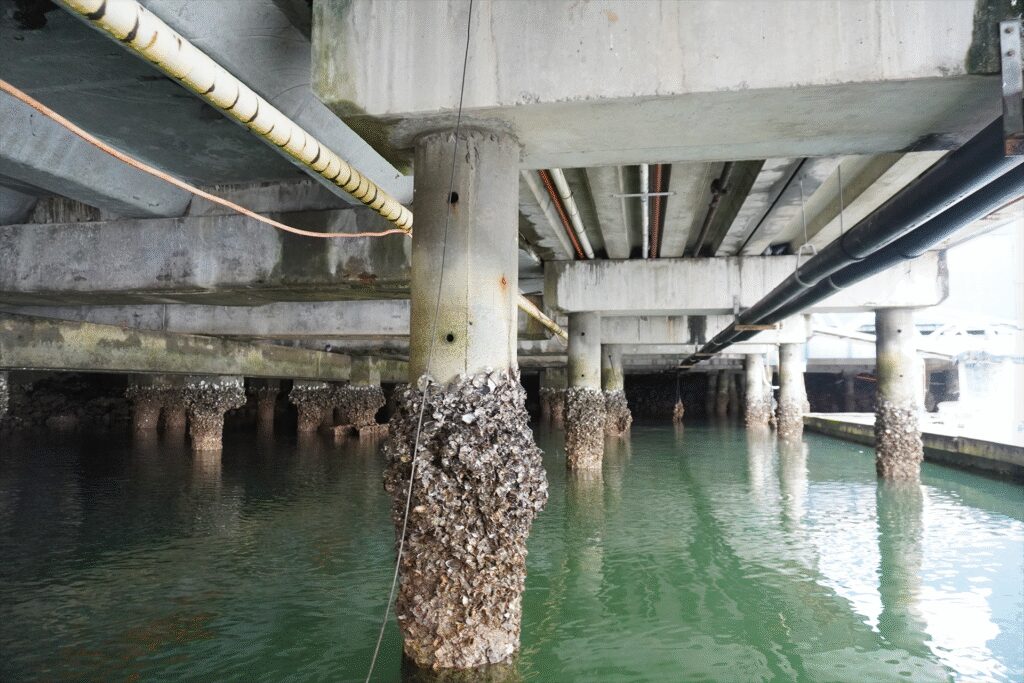
InfrastructureChloride profiling and structural condition assessment of reinforced concrete pier in marine environment
- 03
Highrise Balcony Waterproofing Investigation
StrataInvestigation of balcony membrane failure and corrosion damage across 180 units in 25-storey tower
Frequently asked questions
Gold Coast forensic engineering FAQs
Q01
How do you assess chloride-induced corrosion in Gold Coast highrise towers?
We use a combination of testing methods to assess chloride corrosion in coastal buildings. Half-cell potential mapping identifies active corrosion zones in the reinforced concrete. Concrete cores are taken for chloride profiling, which plots chloride concentration against depth and allows us to calculate the time to corrosion initiation and estimate remaining service life using Fickian diffusion modelling. Cover meter surveys confirm reinforcement depth and cover uniformity. Carbonation testing establishes whether carbonation is contributing to the corrosion initiation. Results are integrated into a condition assessment and remediation plan.
Q02
What causes balcony waterproofing failure in Gold Coast towers?
Gold Coast balconies are exposed to intense UV radiation, wide thermal cycling, and frequent wind-driven rain. Most membrane systems use polyurethane or similar polymer-based membranes that degrade under UV exposure, losing flexibility and developing micro-cracks over time. Cyclic thermal expansion and contraction of the concrete substrate further stresses the membrane at joints, penetrations, and upstands. Once the membrane fails, water enters the slab, initiates reinforcement corrosion, and eventually causes concrete spalling from the balcony soffit. We identify the failure mode, assess the extent of structural damage, and specify a repair and replacement membrane system.
Q03
Can you carry out a forensic investigation after a cyclone event on the Gold Coast?
Yes. We can mobilise for post-cyclone structural assessment within 24 hours of a request. Our priority is to assess structural safety and identify elements requiring immediate make-safe attention. We document wind damage, water infiltration damage, and assess whether the structural system has been compromised. Reports are structured to support insurance claims, occupancy decisions, and building rectification planning. We understand that speed is critical in the aftermath of a cyclone event, particularly for high-rise buildings where occupant safety decisions cannot wait.
Q04
How do you investigate strata building defects on the Gold Coast?
Gold Coast strata defect investigations follow the requirements of the Body Corporate and Community Management Act 1997 (QLD) and the Queensland Building and Construction Commission Act 1991. We inspect common property and lot elements, document and categorise defects, identify responsible parties where possible, and prepare reports suitable for body corporate committee meetings, QCAT proceedings, and defect liability negotiations. We have investigated defects across a range of Gold Coast strata buildings from small boutique complexes to large-scale resort towers.
Other locations
We operate Australia-wide
Forensic investigations across all major Australian capital cities and regional centres.