Non-Destructive Testing / FILE 08
Concrete Coring & Laboratory Testing
Core extraction and laboratory testing provide the definitive material data for structural assessment. We combine GPR-guided core location selection with NATA-accredited testing for compressive strength, carbonation, chloride content, and petrographic analysis.
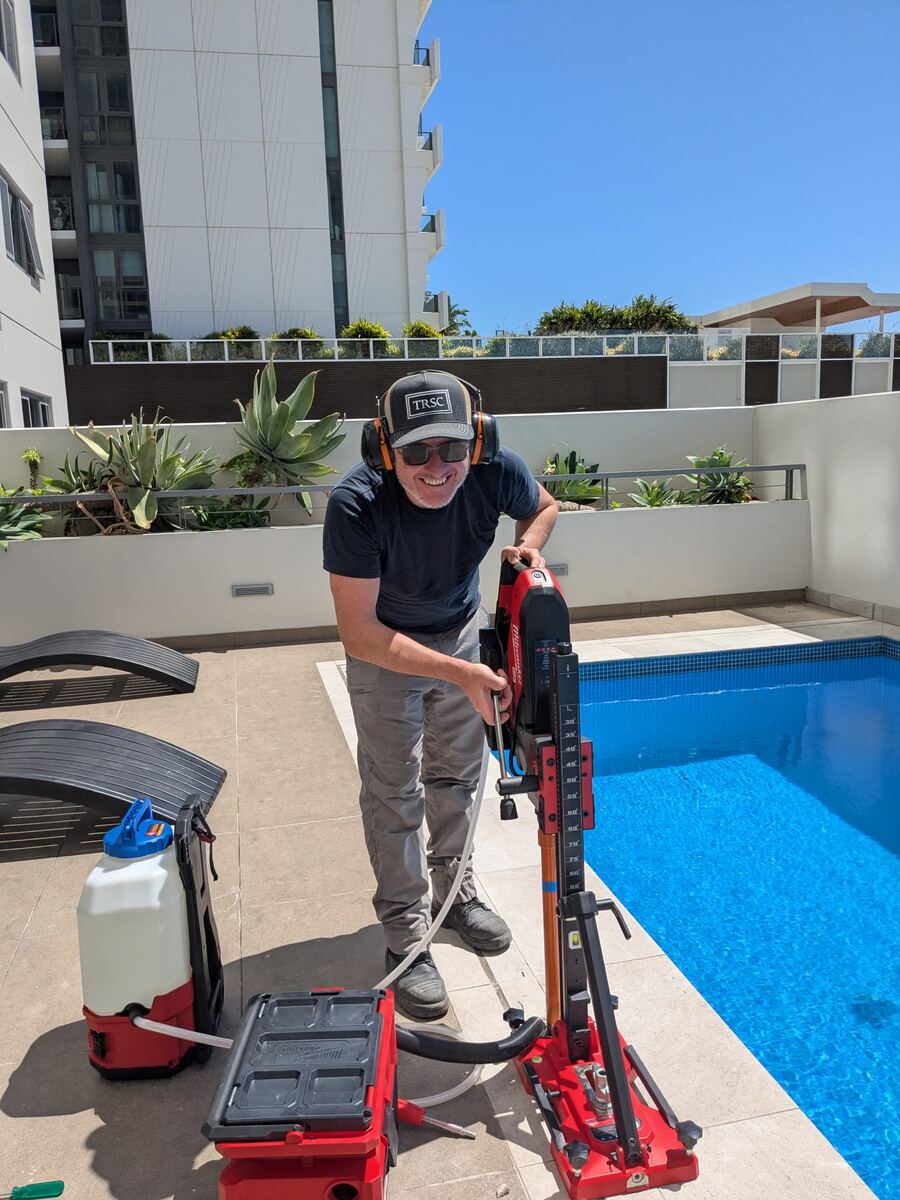 EVIDENCE / CONCRETE-COR
Concrete coring extracts cylindrical samples from existing structures for laboratory testing. Core test results provide the measured material properties that underpin structural calculations, durability modelling, and remediation design. No amount of non-destructive testing can replace direct measurement of compressive strength, chloride concentration, or carbonation depth.
We use GPR and Ferroscan at every proposed core location to confirm safe clearance from reinforcement, post-tensioning tendons, and embedded services before drilling. Core locations are selected based on investigation objectives, guided by NDT results to maximise information while minimising the number of cores required.
Cores are submitted to NATA-accredited laboratories (ISO/IEC 17025) for testing. Common tests include compressive strength (AS 1012.9), carbonation depth (phenolphthalein indicator), chloride ion profiling (AS 1012.20), petrographic analysis (ASTM C856), and density and absorption measurement.
After core extraction, holes are repaired with structural grout to restore the element integrity. The repair grout is selected to match the existing concrete strength and colour where appearance is a consideration.
Capabilities
What we deliver
10 deliverables across the coring & lab testing engagement.
- 01GPR and Ferroscan pre-scanning at every core location
- 02Diamond core extraction (50mm, 75mm, 100mm diameter)
- 03Compressive strength testing to AS 1012.9
- 04Carbonation depth measurement
- 05Chloride ion profiling to AS 1012.20
- 06Petrographic analysis (ASTM C856)
- 07Density and water absorption testing
- 08Alkali-silica reaction (ASR) assessment
- 09NATA-accredited laboratory certification
- 10Core hole repair with structural grout
Process
Our methodology
01
Pre-Scan & Location Selection
GPR and Ferroscan scanning of proposed core locations to confirm safe clearance from reinforcement and services. Final core positions are marked based on NDT results and investigation objectives.
02
Core Extraction
Diamond core drilling using wet or dry methods as appropriate. Cores are labelled, photographed, and packed for transport to the laboratory.
03
Laboratory Testing
NATA-accredited testing including compressive strength, carbonation depth, chloride profiling, petrographic analysis, and other tests as specified. Certified test reports are issued.
04
Interpretation & Reporting
Engineering interpretation of laboratory results in the context of the structural investigation. Assessment of material condition, compliance with design intent, and implications for structural adequacy.
Use cases
Common applications
- Structural capacity assessment of existing buildings
- Durability modelling and remaining life estimation
- Corrosion risk assessment in coastal structures
- Fire damage severity evaluation
- Remediation design input data
- Quality dispute investigation
- Heritage building material characterisation
- Change-of-use structural review
Frequently asked questions
4 questions answered.
Q01
How many cores are needed for a structural assessment?
The number of cores depends on the building size, the variability of concrete quality, and the investigation objectives. AS 3600 Appendix B provides guidance for strength assessment based on the number of results. A minimum of three cores per assessment zone is typical. For a complete building investigation, 6 to 15 cores is common, guided by prior NDT screening results to target the most critical areas.
Q02
Does coring damage the structure?
Coring creates a cylindrical hole (typically 75mm diameter) that is repaired immediately with structural grout. When core locations are selected using GPR to avoid reinforcement, the structural impact is negligible. The small loss of concrete cross-section is less than 0.1 percent of most structural elements. Core holes in exposed or architectural concrete are repaired with colour-matched grout.
Q03
What is carbonation and why does it matter?
Carbonation is the reaction of atmospheric carbon dioxide with calcium hydroxide in concrete, producing calcium carbonate and reducing the pH. When the carbonation front reaches the reinforcement depth, the protective passive layer on the steel is lost and corrosion can initiate. Measuring carbonation depth tells us how far this process has progressed and, combined with cover depth data, allows prediction of when corrosion will begin.
Q04
What is chloride profiling?
Chloride profiling measures chloride ion concentration at incremental depths (typically 10mm intervals) from the concrete surface. Chloride ions from seawater, de-icing salts, or contaminated aggregates penetrate concrete over time. When chloride concentration at the reinforcement depth exceeds the corrosion threshold (approximately 0.4 to 0.6 percent by weight of cement), corrosion initiates. The profile data enables mathematical modelling of remaining service life.
Related
Related services
- 01GPR Concrete ScanningSub-surface imaging for rebar mapping, post-tension tendon location, and conduit detection.
- 02Corrosion InvestigationHalf-cell potential mapping, resistivity testing, and reinforcement condition assessment.
- 03Forensic EngineeringRoot cause failure analysis for structural collapses, defects, and disputes.
- 04Remediation DesignEngineering repair specifications for concrete protection, structural strengthening, and life extension.